


How can an industrial company structure its supply chain for growth without adding more complexity for planning teams? This was the challenge faced by Blanchon Group after several years of transformation. Blanchon is a leading European manufacturer of wood treatment and finishing products, operating in more than 50 countries with over 400 employees. As the
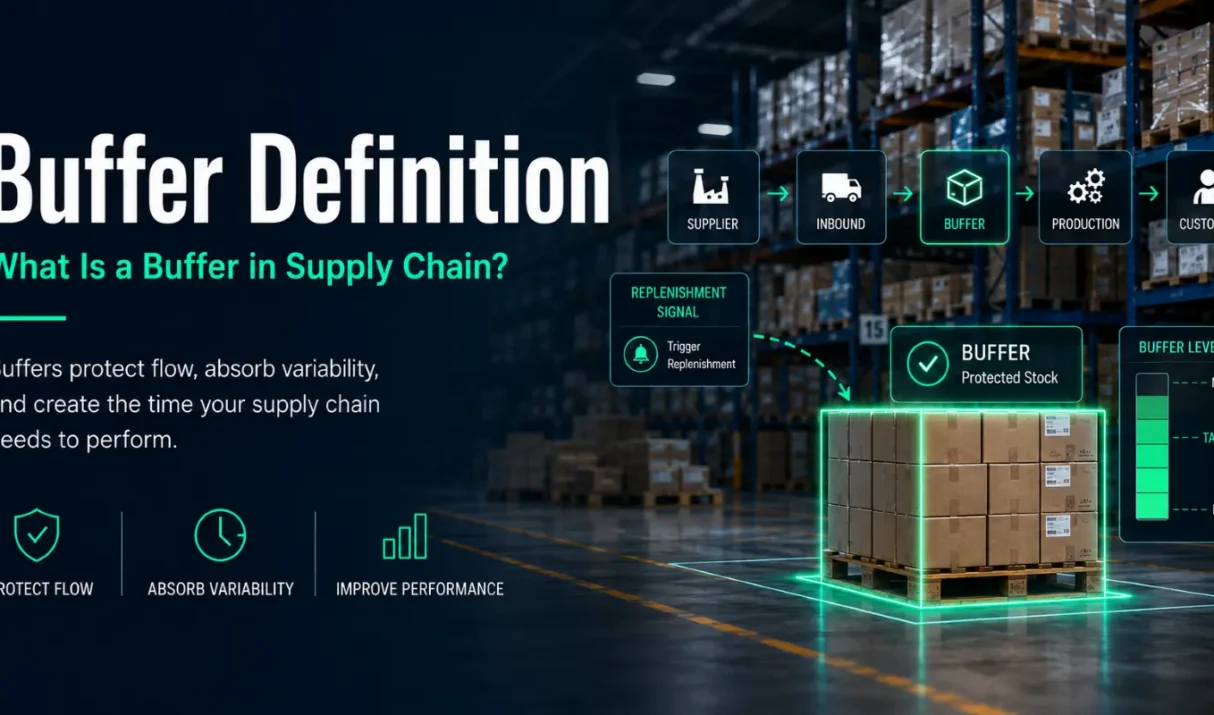
In supply chain, a buffer is a protection mechanism placed at a strategic point to absorb demand variations, supplier delays or operational uncertainty. Its role is not simply to add stock “just in case”. A buffer is used to protect flow, meaning the smooth movement of materials, information and decisions across the supply chain. In

In supply chain planning, the terms DDMRP and DDOM are often used together. This is understandable because both are part of the demand-driven approach to supply chain management. However, they do not mean the same thing. The key difference is simple: DDMRP is a planning methodology, while DDOM is the operating model that uses demand-driven

In today’s supply chain environment, companies are dealing with increasing complexity, uncertainty and demand variability. Traditional planning methods, which rely heavily on forecasts, often fail to provide the level of responsiveness and stability required to operate efficiently. As a result, many organizations struggle with excess inventory, frequent stockouts, declining service levels and overall inefficiencies. This

In today’s manufacturing environments, increasing throughput without adding more resources is one of the biggest challenges. Variability, bottlenecks and inefficient scheduling often prevent companies from achieving stable and efficient production flow. This is where Drum Buffer Rope (DBR) becomes highly relevant. As a core concept of the Theory of Constraints (TOC), DBR focuses on managing

DDMRP implementation enables companies to shift from forecast-driven planning to a demand-driven approach. In today’s volatile supply chain environment, this transition is critical to improving operational performance and resilience. Rather than trying to predict demand with precision, DDMRP focuses on absorbing variability through strategically positioned inventory buffers. This results in improved product availability, reduced inventory

DDMRP (Demand Driven MRP) and MRP (Material Requirements Planning) are both inventory planning methodologies — but they work infundamentally different ways. MRP pushes inventory based on forecasts, while DDMRP pulls inventory based on actual demand signals. For companies operatingin volatile or complex supply chains, DDMRP consistently delivers better results: lower inventory, higher availability, and fewer

Industrial planning is undergoing a true revolution. In a world where demand is increasingly unpredictable, supply chains are becoming more complex, lead times are getting longer, and stockouts are a daily challenge. In response to these issues, the DDMRP (Demand Driven Material Requirements Planning) method is emerging as a practical and effective solution to build

In an environment as large and demanding as SNCF, ensuring the availability of parts for trains in operation is a daily challenge. With thousands of part numbers, constantly changing demand, and strict reliability requirements, every stockout can have major consequences on rail service. To address these challenges, SNCF Voyageurs decided to undertake a deep transformation